
Knee osteoarthritis exercises can help reduce pain, strengthen the muscles around your knee and make everyday movement easier. Six home exercises include seated knee extensions, sit-to-stands, heel slides, supported heel raises, standing knee bends and low step-ups. Start with movements that address your main difficulty, whether that is stiffness, getting out of a chair or managing stairs. Walking can complement your strengthening routine.
Most exercises require only a sturdy chair, a stable support and space to move comfortably.
Why Does Exercise Help Knee Osteoarthritis?
Exercise is a recommended first-line treatment for knee osteoarthritis (OA). Strengthening the muscles that support the knee can improve function, while regular physical activity helps manage pain and stiffness.
Osteoarthritis affects cartilage, bone and other joint tissues. When knee pain leads to inactivity, muscle strength can decline, making standing, walking and climbing stairs more difficult.
Exercise does not reverse established cartilage changes. However, improving strength and physical capacity can make everyday movement easier.
Australia’s 2024 Osteoarthritis of the Knee Clinical Care Standard recommends personalised exercise and physical activity, including for people with severe osteoarthritis when appropriately adapted.
The guideline also explains that some discomfort during suitable exercise does not necessarily mean the knee is being damaged.
Which Knee Osteoarthritis Exercise Should You Start With?
The most useful starting exercise depends on which everyday movement is difficult.
| Your main difficulty | Exercise to consider | Practical adjustment |
|---|---|---|
| Getting out of a chair | Sit-to-stands | Use a higher chair or armrests |
| Stiffness when bending | Heel slides | Work through a comfortable range |
| Difficulty straightening the knee | Seated knee extensions | Avoid forcing the knee straight |
| Calf weakness during walking | Supported heel raises | Hold a stable bench |
| Difficulty bending the knee while standing | Standing knee bends | Keep the trunk still |
| Difficulty climbing low steps | Supported low step-ups | Use a low step and handrail |
| Poor standing balance | Seated exercises initially | Seek assessment for significant balance problems |
For example, someone having trouble getting out of a chair can work on supported sit-to-stands. If bending the knee is the main limitation, heel slides provide a less demanding way to practise the movement.
This table is a guide to exercise selection, not a way to diagnose the cause of knee pain.
6 Knee Osteoarthritis Exercises You Can Do at Home
These movements target knee mobility, quadriceps strength, calf strength and functional movement.
The starting repetitions are general examples. Select a comfortable amount and modify the exercises if symptoms or balance make a movement difficult.
1. Seated Knee Extensions — Strengthen Your Thigh Muscles
Seated knee extensions target the quadriceps, which help straighten the knee during walking, standing and stair climbing.
How to do it:
- Sit upright in a sturdy chair, with both feet on the floor.
- Slowly straighten one knee, lifting your foot.
- Hold for two to five seconds.
- Lower the foot in a controlled movement.
- Repeat with the other leg.
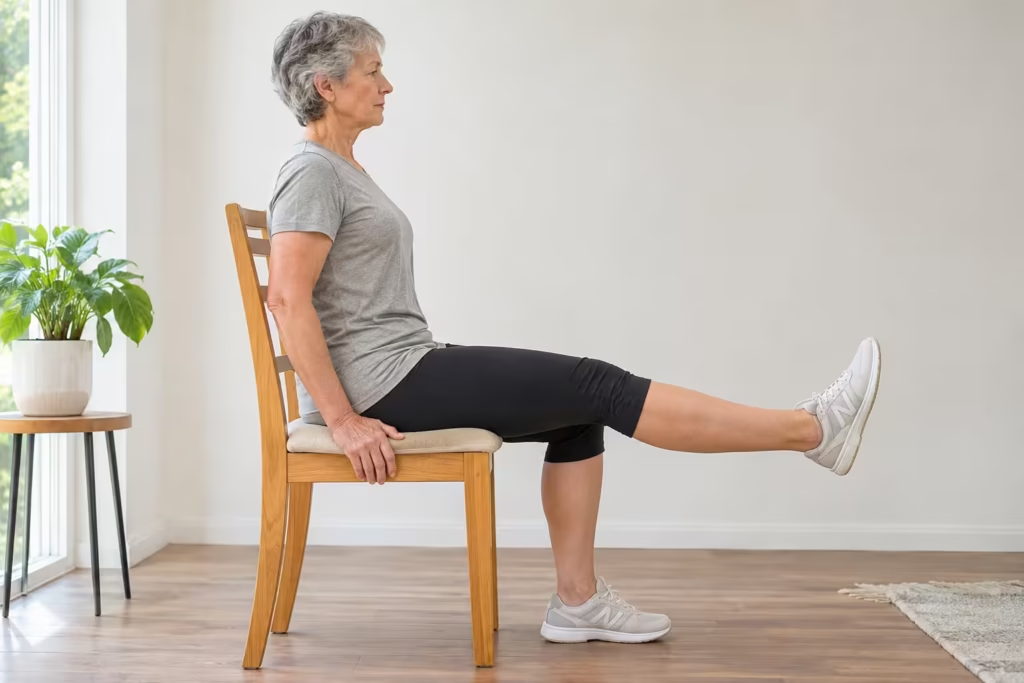
Starting amount: 5–10 repetitions per leg.
If the movement hurts near full extension, straighten only as far as comfortable.
Common mistake: Swinging the leg instead of controlling the movement.
Visual demonstration to add: Side-view photograph showing the starting position and the knee extended, with the thigh supported by the chair.
2. Sit-to-Stands — Improve Getting Out of a Chair
Sit-to-stands strengthen the thighs and hips while practising an everyday movement.
How to do it:
- Sit near the front of a stable chair.
- Place your feet approximately hip-width apart.
- Lean slightly forward from your hips.
- Push through your feet to stand.
- Lower yourself slowly into the chair.
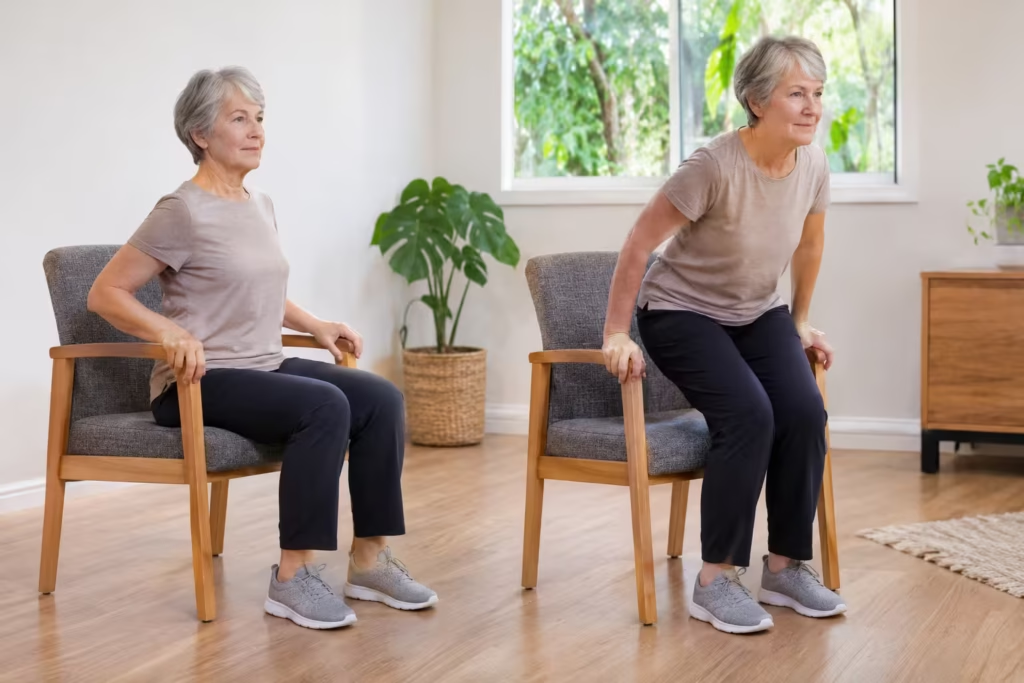
Starting amount: 5 repetitions.
Easier variation: Use a higher chair or gently push from its armrests.
Avoid dropping heavily into the seat. A slow, controlled return is part of the exercise.
Visual demonstration to add: Supported sit-to-stand using armrests beside a standard sit-to-stand.
3. Heel Slides — Improve Knee Bending
Heel slides help move the knee through a comfortable range without placing your full body weight through the joint.
How to do it:
- Lie on your back on a stable bed or comfortable exercise surface.
- Begin with your legs comfortably straight.
- Slowly slide one heel towards your bottom.
- Bend your knee until you reach a comfortable limit.
- Slide the heel away again.
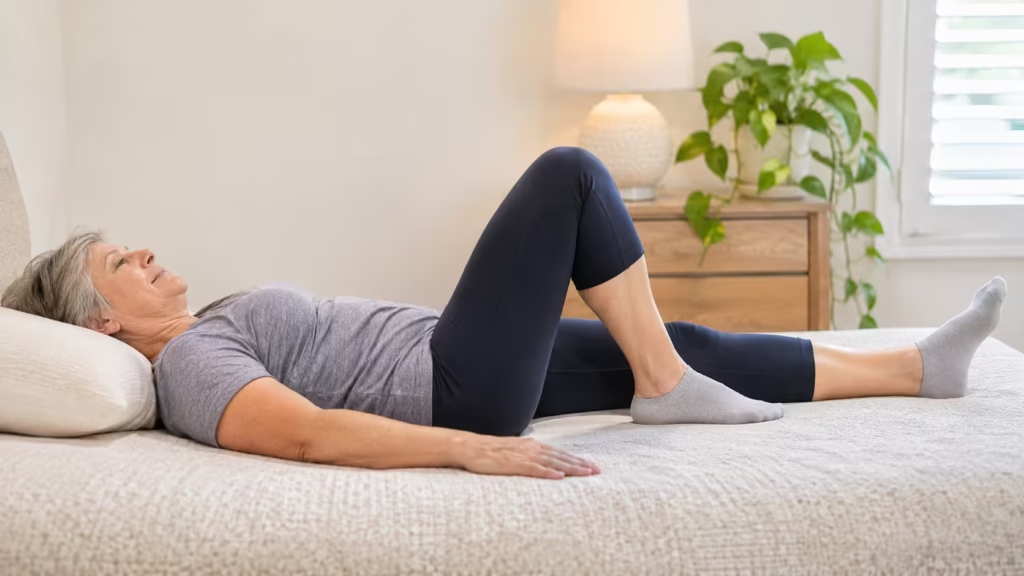
Starting amount: 5–10 repetitions per leg.
If getting onto the floor is difficult, perform the exercise on a stable bed or use a clinician-recommended seated variation.
Common mistake: Forcing the heel towards the body to achieve a deeper bend.
Visual demonstration to add: Starting and bent-knee positions showing the heel remaining supported.
4. Supported Heel Raises — Build Calf Strength
Heel raises strengthen the calf muscles used during walking and standing.
How to do it:
- Stand behind a sturdy chair or beside a stable bench.
- Hold the support with both hands if needed.
- Slowly lift both heels from the floor.
- Pause briefly.
- Lower them with control.
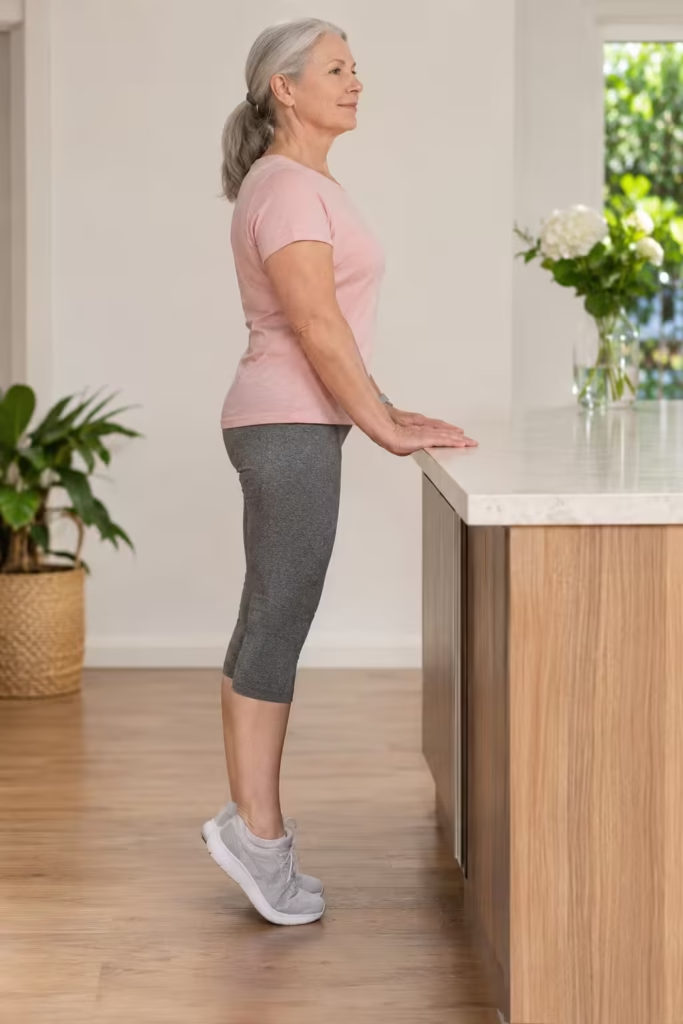
Starting amount: 5–10 repetitions.
Keep both hands supported if your balance is uncertain.
Visual demonstration to add: Heel raise with both hands resting on a stable kitchen bench.
5. Standing Knee Bends — Activate Your Hamstrings
Standing knee bends activate the muscles at the back of the thigh while practising controlled knee movement.
How to do it:
- Stand upright while holding a stable support.
- Bend one knee, bringing the heel towards your bottom.
- Keep your thighs relatively close together.
- Pause briefly.
- Lower your foot slowly.
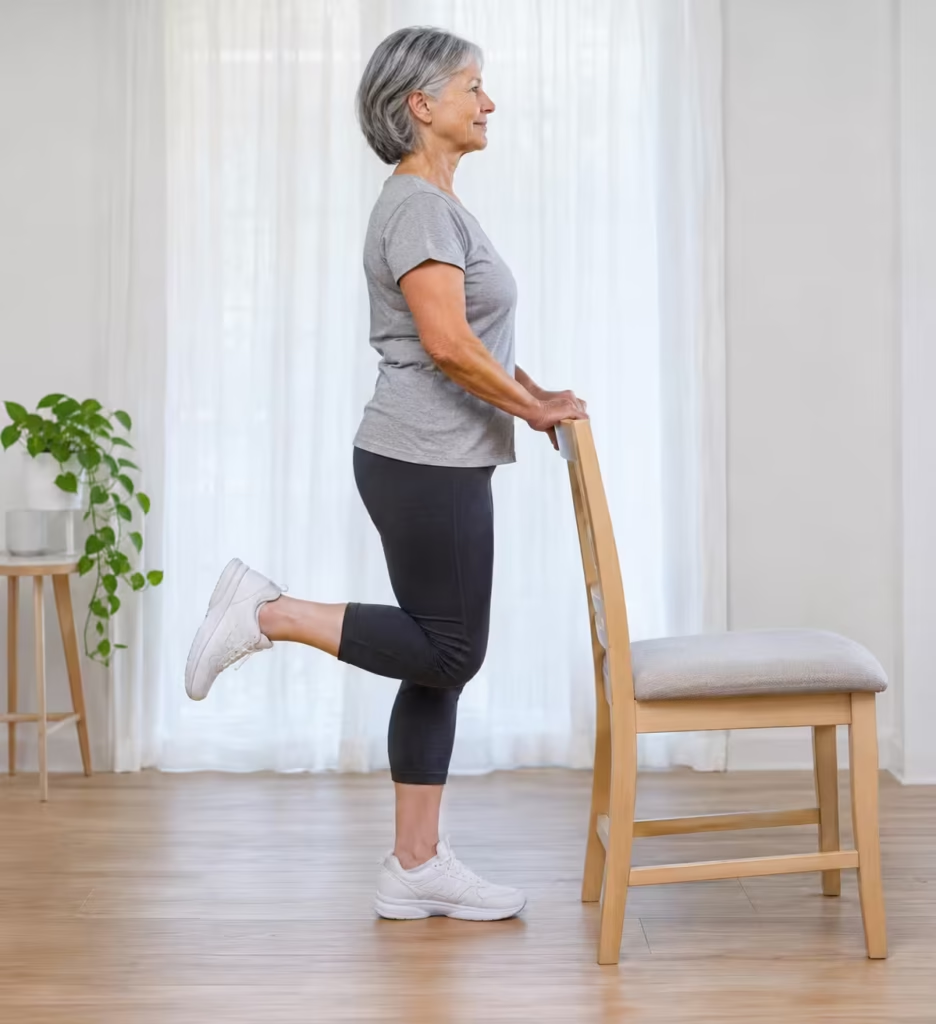
Starting amount: 5–10 repetitions per leg.
Keep your back steady rather than arching it or swinging your leg.
Visual demonstration to add: Side view showing a supported standing hamstring curl.
6. Low Step-Ups — Improve Stair Strength
Step-ups help train the muscles used to climb stairs and negotiate small changes in height.
They require adequate balance and leg control.
How to do it:
- Stand in front of a low, stable step with a secure handrail.
- Place one foot fully on the step.
- Push through that foot to raise your body.
- Bring your other foot up if comfortable.
- Step down slowly using the handrail for balance.
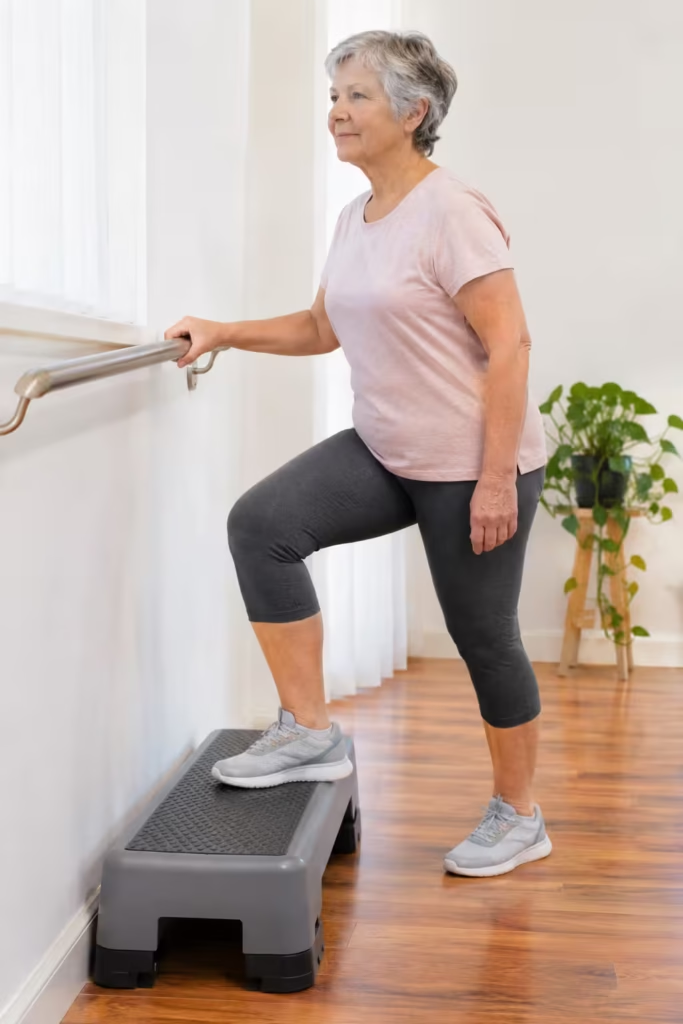
Starting amount: 3–5 repetitions per side.
Choose a lower step if the exercise is too demanding. Avoid step-ups if your knee repeatedly gives way or you cannot balance safely.
Visual demonstration to add: Low step-up using a handrail, with the entire foot supported on the step.
For additional illustrations, see the RACGP knee-strengthening exercise handout.
How to Build a Knee Osteoarthritis Exercise Routine at Home
For a simple home session, begin with heel slides for mobility, followed by seated knee extensions and supported sit-to-stands for strength. If you can stand safely, supported heel raises can also be included.
Use the starting repetitions below. Allow recovery between more demanding strengthening sessions.
| Order | Exercise | Starting amount |
|---|---|---|
| 1 | Heel slides | 5–10 per leg |
| 2 | Seated knee extensions | 5–10 per leg |
| 3 | Supported sit-to-stands | 5 |
| 4 | Supported heel raises | 5–10 |
For many adults, two or three strengthening sessions per week can provide a practical starting schedule, with activity adjusted to fitness and symptoms.
How to Increase Exercise Difficulty Safely
Before making an exercise harder, check:
- Movement control: Can you perform each repetition without losing balance or jerking?
- Effort: Does the exercise feel challenging but manageable?
- Recovery: Has your knee settled towards its usual symptom level by the next day?
When all three are satisfactory, increase one element at a time.
For example, progress from five controlled sit-to-stands to seven before trying a lower chair.
Increasing repetitions, resistance and exercise difficulty simultaneously can make it difficult to identify what is aggravating symptoms.
The RACGP’s exercise resources support progressive strengthening, with the amount of exercise adjusted according to pain, swelling and tolerance.
What If Your Knee Hurts During or After Exercise?
Some temporary discomfort is common when beginning an exercise routine for knee osteoarthritis.
A pain-monitoring scale can help you judge whether the current exercise load is manageable.
| Pain rating | Suggested response |
|---|---|
| 0–3 out of 10 | Usually manageable if the movement remains controlled |
| 4–5 out of 10 | May be acceptable for some people; monitor recovery |
| 6–10 out of 10 | Excessive; reduce or stop the exercise |
The NHS Inform knee exercise guidance uses a similar symptom-monitoring approach.
Your knee should not be substantially worse the following morning. If pain or swelling remains elevated, reduce the repetitions, resistance or movement range at the next session.
Common Exercise Problems and What to Change
| Problem | Adjustment |
|---|---|
| Sit-to-stands cause pain | Use a higher chair or fewer repetitions |
| Step-ups feel too demanding | Lower the step or return to sit-to-stands |
| Heel slides increase discomfort | Reduce the bending range |
| Swelling increases after exercise | Reduce the previous session’s load and seek advice if persistent |
| You fatigue before finishing | Divide the routine into shorter sessions |
| Standing feels unstable | Use seated exercises and consider balance assessment |
Stop and seek appropriate medical advice for severe pain, new locking, substantial swelling or repeated giving way.
A hot, markedly swollen knee accompanied by fever or feeling unwell needs urgent medical assessment.
Is Walking Good for Osteoarthritis in the Knee?
Yes. Walking is generally beneficial for knee osteoarthritis because it helps maintain mobility, cardiovascular fitness and everyday function. Comfortable walking can support pain management, particularly when combined with targeted strengthening exercises.
If your goal is to improve getting out of a chair or climbing stairs, combine walking with sit-to-stands or seated knee extensions.
If longer walks increase your symptoms, try shorter sessions on level ground and build up according to your recovery.
Cycling, water-based exercise and Tai Chi are other activities that can form part of an osteoarthritis exercise programme.
Knee Osteoarthritis Exercises for Older Adults
Older adults can perform many of the same knee exercises as younger adults, but the safest starting point depends on mobility and balance.
If standing from a low chair is difficult, try sit-to-stands using a higher chair with armrests.
If standing balance is uncertain, begin with seated knee extensions or suitable heel slides instead of step-ups.
Use a stable support for standing exercises. Frequent falls, significant knee instability or difficulty standing independently are reasons to seek professional assessment before progressing.
Strengthening exercise can remain beneficial in older age, including for people with advanced osteoarthritis.
Which Knee Arthritis Exercises Should You Avoid?
There is no universal list of exercises that everyone with knee osteoarthritis must avoid.
Deep squats, running and higher step-ups are not automatically harmful, but they can exceed a person’s current strength or exercise tolerance.
Instead of avoiding every demanding movement permanently, consider whether a modified version is appropriate.
For example, a supported sit-to-stand may be a better starting point than a deep squat. A low step-up may be more manageable than repeated climbing on a full-height staircase.
New instability, significant swelling or worsening pain are reasons to seek guidance before increasing difficulty.
Free Physiotherapy Exercises for Knee Osteoarthritis: PDF
The Royal Australian College of General Practitioners publishes an illustrated knee-strengthening exercise resource through its Handbook of Non-Drug Interventions.
View RACGP Knee Strengthening Exercises (PDF)
The resource offers further instructions and guidance for people who prefer a printable format.
When Is a Personalised Knee Exercise Plan Needed?
An individual assessment is useful when symptoms make everyday activities difficult or when the knee repeatedly gives way, locks or remains swollen.
Someone struggling to rise from a chair may benefit from an assessment of lower-limb strength and functional movement. Someone whose knee gives way while stepping needs stability and balance considered before attempting more demanding step-ups.
A clinician can also assess whether osteoarthritis fully explains the symptoms or whether further investigation is needed.
Knee Osteoarthritis Assessment at HealthiClinic
HealthiClinic provides knee osteoarthritis assessment and coordinated musculoskeletal care in Greenwich, Sydney.
Dr Carlos Tahuil-Ochoa, FRACGP is a specialist general practitioner whose published clinical scope includes knee osteoarthritis and other musculoskeletal conditions.
Assessment may involve reviewing symptoms, medical history, functional limitations and whether individualised rehabilitation or additional investigation is appropriate.
HealthiClinic also provides rehabilitation and musculoskeletal training.
Learn more about knee osteoarthritis assessment and management at HealthiClinic.
Choosing Your Next Step
Choose an exercise that addresses a movement you want to improve, such as rising from a chair, bending your knee or climbing a step. Begin with a manageable amount and pay attention to how your knee feels afterward.
If pain, swelling or instability makes these movements difficult, an individual assessment can help determine what to change.
HealthiClinic provides knee osteoarthritis assessment and coordinated musculoskeletal care in Greenwich, Sydney.
For further information:
- Knee Osteoarthritis Assessment and Management
- Rehabilitation and Musculoskeletal Training
- Dr Carlos Tahuil-Ochoa — Practitioner Profile
- Contact HealthiClinic
Evidence and Medical References
- Australian Commission on Safety and Quality in Health Care. Osteoarthritis of the Knee Clinical Care Standard (2024).
- Royal Australian College of General Practitioners. Knee Strengthening Exercises — HANDI PDF.
- NHS Inform. Exercises for Osteoarthritis of the Knee.
- HealthiClinic. Knee Osteoarthritis Assessment and Management.
- HealthiClinic. Dr Carlos Tahuil-Ochoa — Practitioner Profile.
What Is the Best Exercise for Arthritic Knees?
There is no single best exercise for everyone. Seated knee extensions can strengthen the quadriceps, sit-to-stands improve functional strength, and walking supports everyday mobility. A combination that matches your abilities and goals is generally more useful than relying on one exercise.
How Can You Lessen Arthritis Pain in Your Knees?
Regular strengthening, comfortable physical activity and sensible adjustments during symptom flare-ups can help manage knee osteoarthritis pain. Medical treatments may also be appropriate. Persistent swelling, instability or severe pain requires assessment.
Are Squats Bad for Knee Osteoarthritis?
Not necessarily. Modified squats and sit-to-stands can strengthen the legs. A higher chair, hand support or smaller bending range can make the movement easier to tolerate.
Can You Exercise With Severe Knee Osteoarthritis?
Yes. Exercise is recommended for many people with advanced knee osteoarthritis, but activities may need modification. People with severe pain, instability or limited mobility should consider supervised exercise guidance.
Should You Exercise Every Day With Knee Osteoarthritis?
Gentle movement can often be performed daily. More demanding strengthening sessions may benefit from recovery time. The appropriate frequency depends on your fitness, symptom response and the intensity of the exercises.