
There is no universal skin-check schedule for Australian adults. Cancer Council recommends regularly examining your own skin and having suspicious changes checked by a doctor. For people at high risk of skin cancer, the RACGP recommends clinical examinations at least every 12 months. Certain people at very high risk of another melanoma require six-monthly examinations. Your medical history and individual risk determine the appropriate schedule.
Australia does not have a population-wide screening programme for skin cancer. Knowing your personal risk is more useful than automatically booking the same yearly appointment as everyone else.
How Often Should You Get a Professional Skin Check in Australia?
Your recommended skin-check frequency depends on factors such as previous skin cancer, family history, mole characteristics and ultraviolet (UV) exposure.
Cancer Council NSW advises regular skin self-examination and prompt assessment of suspicious lesions. For people at higher risk, full-skin examinations supported by photography and dermoscopy may be appropriate every 6–12 months.
The RACGP provides more specific recommendations for high-risk and certain very-high-risk groups.
Skin Check Frequency by Risk Level
| Risk or circumstance | Recommended approach |
|---|---|
| No significant known risk factors | Check your skin regularly; have suspicious changes assessed. Discuss with your GP whether scheduled clinical checks are needed |
| High risk of melanoma or keratinocyte cancer | Clinical skin examination at least every 12 months under RACGP guidance |
| Very high risk of another primary melanoma | Six-monthly full-skin examination, supported by photography and dermoscopy where indicated |
| Previous melanoma or another skin cancer | Follow your treating clinician’s surveillance plan, which may differ from the general schedule |
| New or changing suspicious lesion | Arrange a medical assessment promptly, regardless of when your next routine check is due |
The key distinction: A scheduled skin check monitors ongoing risk. An appointment for a new or changing lesion investigates a current concern and should not be delayed to fit your routine schedule.
Sources: Cancer Council NSW — Checking for Skin Cancer and RACGP — Guidelines for Preventive Activities in General Practice.
Who Needs More Frequent Skin Cancer Checks?
A person with a history of melanoma may need a different surveillance plan from someone with fair skin but no previous skin cancer.
Several factors influence that decision.
Previous Skin Cancer
People who have previously had melanoma, basal cell carcinoma or squamous cell carcinoma may be at increased risk of developing another skin cancer.
Follow-up depends on the cancer type, treatment, relevant pathology results and individual risk.
After melanoma treatment, the treating team’s recommended follow-up schedule takes priority over general screening advice.
Family History of Melanoma
A parent, sibling or child with melanoma can increase your risk. Several relatives with melanoma, particularly at younger ages, may warrant more detailed assessment.
Mention the family relationship and any known age at diagnosis when discussing risk with your doctor.
Numerous or Atypical Moles
Having many moles or several unusual-looking moles can increase melanoma risk.
In some circumstances, clinical photography and dermoscopic imaging can help compare lesions over time.
A mole count alone does not determine whether you should return in six months or twelve months.
Fair Skin and Significant UV Exposure
Risk factors include fair or freckled skin, a tendency to burn, severe past sunburns and substantial lifetime sun exposure.
This is particularly relevant to Australians who work outdoors, including tradespeople, construction workers, landscapers and other workers exposed to UV for extended periods.
Previous sunbed use also contributes to skin cancer risk.
Immunosuppression
Some people with weakened immune systems, including organ transplant recipients and those taking certain immunosuppressive medicines, have a higher risk of skin cancer.
They may need a surveillance plan coordinated with their treating medical team.
How Often Should You Check Your Skin at Home?
Cancer Council recommends becoming familiar with your skin and examining it regularly.
There is no mandatory self-check interval for every Australian. A monthly reminder or a check at the beginning of each season can be a practical habit.
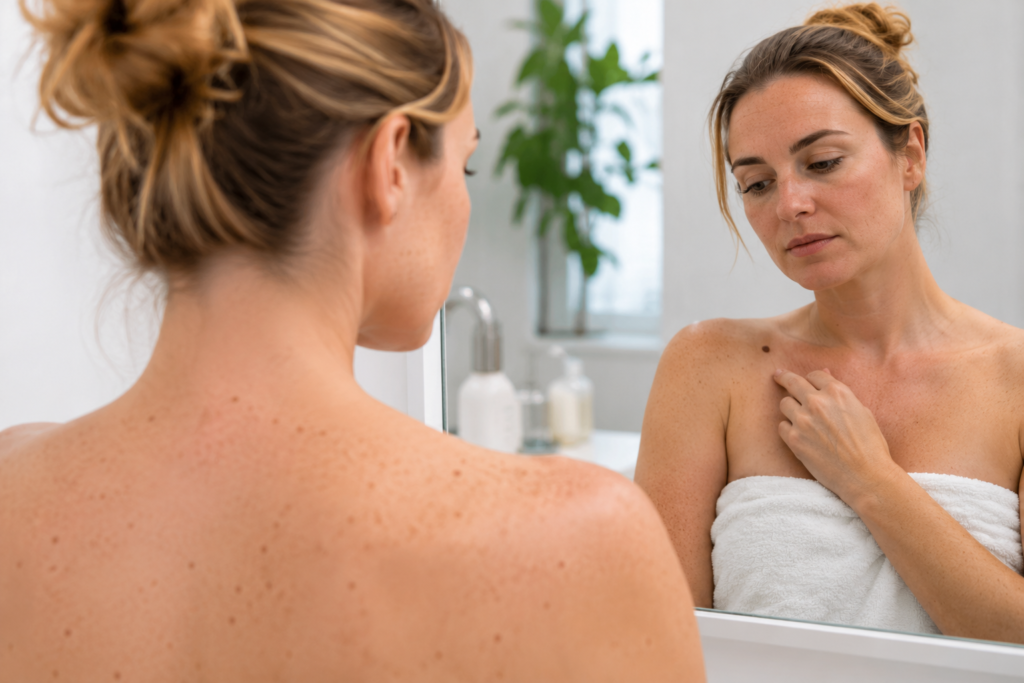
When checking, use good lighting and mirrors to examine your face, scalp, neck, trunk, arms, hands, legs and feet. Remember areas that are difficult to see, such as your back, soles, between the toes and beneath the nails.
Ask someone you trust to help check your back or scalp if necessary.
Can Photographs Help Track a Changing Mole?
A photograph can help document a lesion’s size and appearance.
Taking photographs under similar lighting and from a similar distance makes comparisons more meaningful. Including a ruler can help record dimensions.
However, personal photographs are a record of appearance, not a diagnostic test.
For people with many moles or a high melanoma risk, a clinician may recommend professional total-body photography or digital dermoscopic monitoring.
Cancer Council advises against relying on smartphone apps to diagnose skin cancer.
Source: Cancer Council Australia — Early Detection of Skin Cancer.
Which Skin Changes Should Be Checked Promptly?
Skin cancer does not always begin as a large, dark mole.
Some lesions appear as a changing brown spot, while others may be pink, red, scaly, raised or persistently sore.
Arrange a medical assessment for:
- A new or changing mole
- A spot that looks different from other marks on your skin
- A lesion that bleeds, crusts or repeatedly becomes sore
- A wound or patch that does not heal
- A growing lump or raised spot
- An unusual mark beneath a nail or on the sole of a foot
The ABCDE guide can help identify possible melanoma signs: asymmetry, irregular border, varied colour, diameter and evolution.
Evolution change over time is particularly important. Some melanomas do not follow the familiar ABCDE pattern, so a growing or unusual lesion still warrants assessment even when it looks relatively symmetrical.
See Cancer Council Australia’s guide to signs of skin cancer.
What Happens During a Full-Body Skin Check?
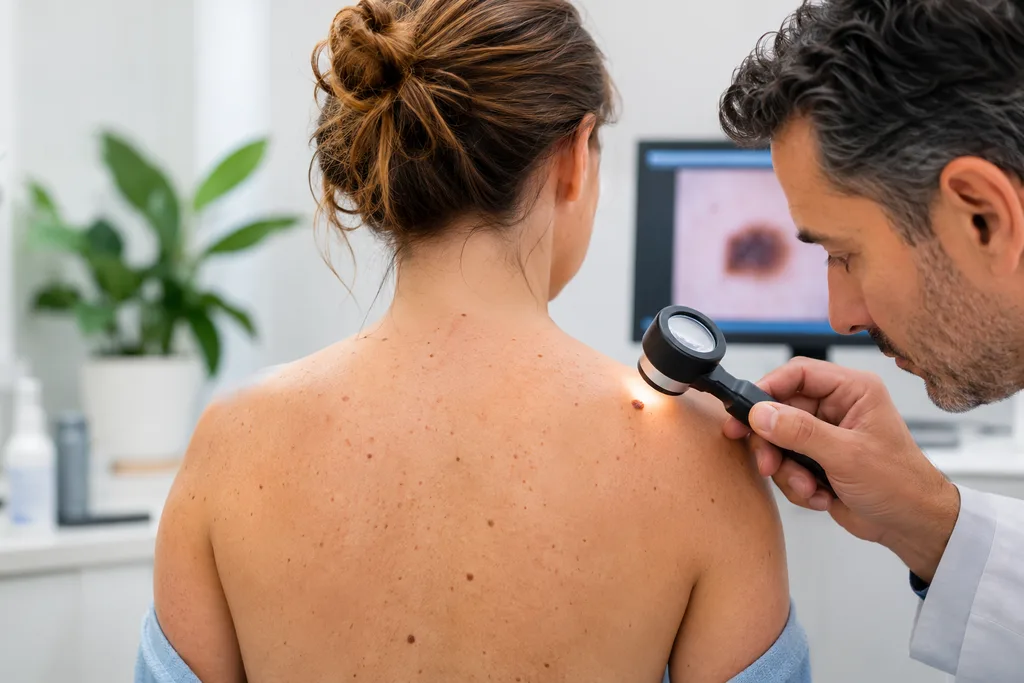
A professional skin check involves reviewing relevant medical history and examining the skin for suspicious lesions.
Your doctor may ask about previous skin cancer treatment, family history, sun exposure and spots that have recently changed.
The examination may include the scalp, face, neck, trunk, limbs, hands and feet, with other areas examined as clinically appropriate.
A clinician trained in dermoscopy may use a handheld instrument called a dermatoscope to examine skin structures that are difficult to see with the unaided eye.
What Happens if a Suspicious Spot Is Found?
An unusual spot does not automatically need to be removed. The next step depends on its appearance, the history of change and the level of clinical suspicion.
The clinician may recommend:
- Further dermoscopic examination: To assess patterns and features not visible during ordinary inspection.
- Planned photographic monitoring: For selected lesions where careful comparison is clinically appropriate.
- Biopsy or excision: When tissue examination is needed to establish a diagnosis.
- Specialist referral: When the lesion is complex, concerning or requires care beyond the clinician’s scope.
If a biopsy is recommended, tissue is sent to a pathology laboratory. Your clinician should explain the reason for the procedure, possible risks, aftercare and how results will be communicated.
A Useful Clinical Distinction: When Is Monitoring Appropriate?
Monitoring and biopsy are not interchangeable choices.
For selected flat or slightly raised pigmented lesions without definite melanoma features, a trained clinician may recommend short-term digital dermoscopic monitoring. The purpose is to look for documented changes that would justify biopsy.
A suspicious raised, firm or growing nodule is different. Australian melanoma guidance cautions against simply monitoring suspicious nodular lesions because delay may be harmful.
Similarly, a lesion with concerning clinical or dermoscopic findings may require biopsy or specialist assessment rather than another photograph several months later.
This decision depends on professional examination and cannot be made reliably from a home photograph.
Why this matters for patients: If your clinician recommends monitoring a spot, ask what changes should prompt an earlier appointment, when it will be reviewed and whether a biopsy would be recommended if it changes.
This explanation reflects Australian clinical guidance on melanoma investigation and monitoring. It is not a statement of Dr Amjad Ali’s personal clinical experience.
Sources: Cancer Council Australia — Early Detection of Skin Cancer and Cancer Council — Melanoma Optimal Care Pathway.
Does Australia’s UV Index Change Your Skin Check Frequency?
The UV Index determines when sun protection is needed, not how often you should book a professional skin check.
Cancer Council recommends sun protection when the UV Index reaches 3 or above. In Sydney, this can occur outside summer.
Covering clothing, shade, a broad-brimmed hat, sunglasses and broad-spectrum SPF50 or SPF50+ sunscreen help reduce UV exposure.
The Cancer Council sun safety resources explain how to protect your skin throughout the year.
Skin Cancer Checks at HealthiClinic Greenwich
HealthiClinic offers skin cancer and mole assessments in Greenwich, Sydney.
Patients who have noticed a changing mole, have previously been treated for skin cancer or want advice about their individual risk can enquire about a clinical assessment.
Dr Amjad Ali — General Practitioner and Skin Cancer Clinician
Dr Amjad Ali is a general practitioner at HealthiClinic with a published special interest in skin cancer detection, diagnosis and management.
His practitioner profile describes full-body skin examinations, lesion assessment, skin biopsy procedures and treatment planning.
These services are directly relevant to patients who want a risk assessment or need a suspicious spot examined.
The clinic’s published skin cancer service includes:
- Skin cancer checks
- Mole and lesion assessment
- Skin biopsies where clinically indicated
- Advice on preventive skin health
You can review the available services on HealthiClinic’s Skin Cancer page.
To confirm appointment availability, consultation arrangements or whether a particular investigation is offered at your appointment, contact HealthiClinic.
Editorial disclosure: Dr Ali’s practice areas are verified from his published profile. He has not yet been confirmed as the author or medical reviewer of this article.
Need a Skin Check in Greenwich, Sydney?
If you’ve noticed a new or changing mole, a sore that isn’t healing or another unusual skin lesion, arrange a medical assessment rather than waiting for your next routine appointment.
HealthiClinic provides skin cancer and mole assessments in Greenwich on Sydney’s Lower North Shore.
Explore HealthiClinic’s skin cancer checks and assessments or contact the clinic to enquire about appointments.
Australian Medical References
- Cancer Council NSW. Checking for Skin Cancer. Australian advice on skin-check frequency and self-examination.
- Royal Australian College of General Practitioners (RACGP). Guidelines for Preventive Activities in General Practice. Risk-based clinical skin examination recommendations.
- Cancer Council Australia. Early Detection of Skin Cancer. Dermoscopy, clinical photography and melanoma detection.
- Cancer Council Australia. Melanoma Optimal Care Pathway. Clinical assessment, investigation and referral guidance.
- Cancer Council Australia. Diagnosing Skin Cancer. Explanation of skin examination and biopsy procedures.
- Cancer Council Australia. Check for Signs of Skin Cancer. Skin lesion warning signs and self-examination.
- HealthiClinic. Skin Cancer Services. Available clinical skin assessment services.
- HealthiClinic. Dr Amjad Ali — Practitioner Profile. Published clinical scope.
Can a GP Perform a Full-Body Skin Check?
Yes. GPs can perform clinical skin examinations within their training and scope of practice. Some have additional training in dermoscopy and skin cancer management. Your GP can also arrange a biopsy or refer you to an appropriate specialist when needed.
Should I Wait Until My Next Skin Check if a Mole Changes?
No. A changing mole, growing lump, bleeding lesion or sore that does not heal needs prompt assessment. Routine appointments are for planned monitoring, not for delaying investigation of a new concern.
Does Previous Melanoma Change How Often I Need Skin Checks?
Yes. People treated for melanoma usually require a structured follow-up plan. The interval depends on the melanoma’s characteristics, treatment and individual risk. Follow the schedule recommended by your treating team.
Is Mole Mapping Necessary at Every Skin Check?
No. Total-body photography or digital dermoscopic monitoring is particularly useful for selected people with many moles or higher melanoma risk. A routine skin examination does not automatically require mole mapping.
At What Age Should Australians Start Professional Skin Checks?
There is no universal starting age for routine professional skin examinations. A person’s risk factors and any suspicious lesions are more relevant than reaching a particular age. New or changing lesions warrant assessment at any age.